
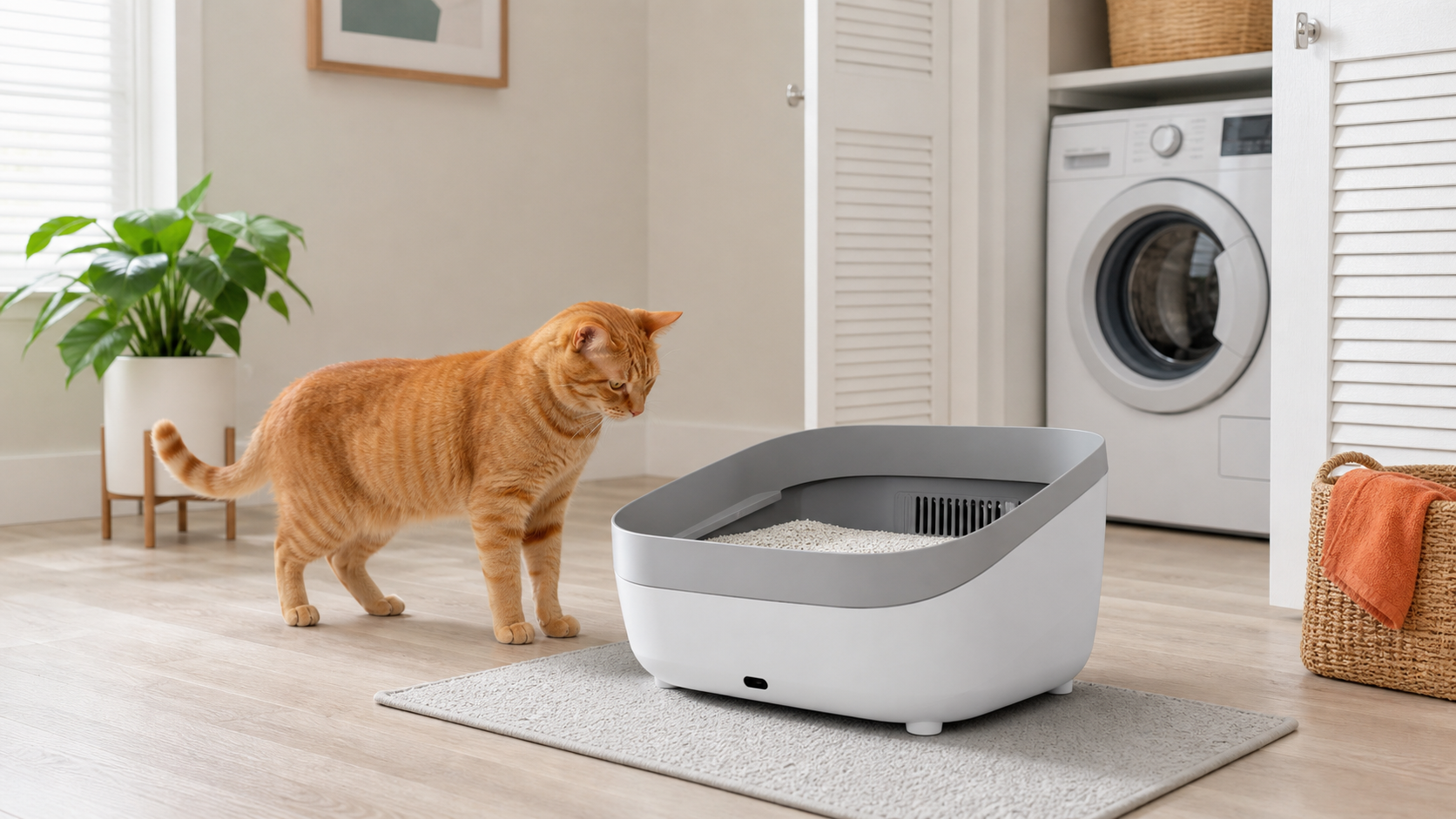
How to Choose an Automatic Cat Litter Box: A Practical Guide

About the Author
The right automatic litter box is the one your cat can enter, turn around in and leave without hesitating, and the one whose cleaning routine you will still be doing in month six. Check cat fit and how the machine stops first. Litter, upkeep, space, noise, cost and app features are tiebreakers, not starting points. A machine that clears every spec sheet and unsettles your cat is a machine you will return. That is the single most useful thing we have learned from our own returns data, and it is why how we think about open-top automation starts with the animal rather than the feature list. Automation does not delete the work either — it moves scooping from a daily task to a weekly one, and weekly tasks are exactly the kind people postpone. First decide whether an automatic litter box fits your cat Look at the cat before you look at the category. A confident adult cat with steady mobility will accept most designs. A cautious cat, a senior with stiff hips, a large-bodied cat or one with any history of going outside the box needs a stricter check and a slower introduction. AAHA's litter box guidance [5] lists cleanliness, litter type, placement, usable size, noise and mobility as the factors that decide whether a cat keeps using a box, and notes that self-cleaning boxes can startle skittish cats. Read that as a scheduling instruction rather than a warning: budget two weeks for the introduction instead of two days. Figure 2. Who an automatic box suits: a confident adult cat, a senior with limited mobility, and a kitten below the minimum age and weight. Our view. The machine is rarely what fails. The introduction is. Our returns cluster in the first fortnight, and when we ask what happened, the answer is almost always that the old litter box was taken away on day one. A cat that loses its known option before it trusts the new one will pick the floor. That is not a fault in the hardware. Delay the purchase entirely if your cat has suddenly started urinating or defecating outside the box, is straining, seems painful, or has changed frequency. A new machine should never be used to paper over a medical or behavioural problem. Understand the main cleaning mechanisms Automatic boxes separate waste in three broad ways. Rotating or sifting systems turn the whole chamber so clumps fall through a screen into a drawer. Raking systems drag clumps across a flat litter bed. Tray systems use proprietary granules, pads or cartridges. The mechanism sets your usable interior, your litter, your consumables, and what happens when a clump breaks apart mid-cycle. Our view. Choosing a mechanism is really choosing a consumables contract. Rotating and raking systems let you buy litter anywhere. Tray systems tie you to one supplier for the life of the machine, and that cost never appears on the product page. Work out what the mechanism obliges you to re-buy before you compare purchase prices. Do not choose by mechanism name alone. Ask what the cat stands on, how waste leaves the litter bed, which parts touch urine or stool, which of those parts can go under a tap, how you reach the waste drawer, and what the manual says to do after an interrupted cycle. 1. Measure your cat and the usable interior Exterior dimensions tell you whether the unit fits the room. They tell you nothing about whether your cat fits the box. What matters is entry width and height, step height, litter-bed dimensions, and the space to stand, turn and dig. Photographs flatter interiors, especially when nothing in frame gives scale. Measure your cat from nose to base of tail as a practical body-length reference. Check that the cat can turn without pressing against a wall, cover or moving chamber. For a senior or mobility-limited cat, look at the first step, the traction and the route to the box. For a large cat, get published interior measurements. "Large-cat friendly" is not a measurement. Confirm the manufacturer's minimum age and weight for automatic operation. Buy for the cat you have at three in the morning. A 15 lb cat that has to reverse out instead of turning around will tolerate it while the litter is fresh and stop tolerating it the week it is not. You will not get a warning — you will find the evidence on a rug. 2. Verify safety behavior and operating limits A safety claim should describe behaviour, not reassure. Read the current manual and look for what the machine does when a cat approaches mid-cycle, whether it pauses or stops, how long the cleaning delay runs, when manual mode is required, and what you are meant to do after an alert. What is the minimum age and weight for automatic operation? Can automatic cleaning be disabled entirely while the cat acclimates? What visible or audible alert appears after an interruption? Does the manual give a safe reset sequence? Can you reach support and a current manual without relying on a community post? Sensor count is marketing; geometry is engineering. Electronic protection depends on sensors reading correctly and firmware behaving. Mechanical protection depends on shape, and a shape has no failure mode. A drum built so it physically cannot complete a full rotation cannot close on a cat even if every sensor in it goes dark. A machine with fourteen sensors and no published stop behaviour tells you less than one with a documented mechanical limit. Figure 4. How a mechanical limit works: the amber path is the rotation the drum can make, the blue bar is the physical stop, and the dashed path is the rotation it cannot complete even if every sensor fails. If you want the clinical framing rather than the engineering one, the AAFP/ISFM house-soiling guidelines [2] set out how quickly a cat's litter box habits break down once the box becomes aversive — which is the real cost of getting this wrong. 3. Check litter compatibility before buying Litter compatibility is the most expensive thing buyers overlook, because it is a recurring cost hiding inside a one-time purchase. Sifting systems need clumps firm enough to survive being moved. Particle size, dust, bed depth and cleaning delay all change whether a clump separates cleanly or smears. Litter that performs well in a manual pan can crumble in a drum. Does the model require clumping litter? Are long pellets, crystal litter or non-clumping litter excluded? Is there a clear MIN/MAX fill line? Can you keep using a familiar litter through the transition? Will changing litter add a monthly cost? Estimate the litter and consumables required over at least one year, not only the purchase price. A lower-cost unit can become more expensive if it requires proprietary trays, liners, filters, or granules. Treat model instructions as final. Do not assume one PetPivot model's litter rule applies to another model in the same family, let alone to every automatic box on the market. Figure 5. Buying factors include measurements, litter, maintenance supplies, power, noise and room layout. 4. Calculate the maintenance that remains Automatic cleaning replaces frequent hand scooping with a smaller set of checks on a schedule. The exact rhythm varies by model, cat count, stool consistency, litter and room conditions, but the shape is consistent. Every few days: litter level, unprocessed waste, residue, drawer status, unusual alerts. Weekly or as needed: empty the waste container before it overfills or becomes an odour source. Monthly: wash the approved removable parts and let them dry completely. Periodically: deep clean chamber, waste bin and visible sensors per the model guide. After reassembly: confirm parts are dry and correctly seated before normal operation. Automation changes the maintenance rhythm; it does not remove maintenance. Check the litter bed and drawer regularly, then attach emptying and washing to an existing household routine so waste does not sit beyond the model’s guidance. Wet parts seated back into a drum are how sensor faults start, so read the maintenance section of the step-by-step setup and cleaning instructions before you order. A model is only convenient if its real cleaning steps fit your schedule and your back. 5. Evaluate odor control without believing absolute claims Automatic waste removal shortens the time clumps sit exposed in the litter bed. That helps. It does not make a system odour-free. Smell returns for findable reasons: saturated litter, a clump that broke apart and left residue on the chamber, a badly fitted liner, or a drawer that is simply full. Odor control depends on how quickly waste is removed, how well the drawer is sealed, litter performance, ventilation, and cleaning. Enclosures may contain some odor but can also retain humidity; open designs improve visibility but still require prompt waste removal. Look for a waste area you can inspect, line, remove, wash and dry without dismantling the machine. Ask whether a seal or filter needs periodic replacement, and whether the drawer can be serviced where the box sits — if servicing means carrying the whole unit to a sink, you will do it less often than you should. Waste-drawer liners are the quiet consumable here, and using them is the difference between rinsing a drawer and scrubbing one. 6. Measure the full home footprint Listed width and depth are only the first measurement. Add room for the cat to approach and leave, for the drawer to slide out, for washable parts to lift clear, for a litter bag to tip in, and for your hand to reach the controls. Check the route from the delivery door to the final spot as well; these arrive in large cartons and the awkward moment is usually a stair turn. Use a flat, stable indoor floor. Keep the box away from food and water. Avoid placing it beside a loud appliance, or in a corner where another pet can block the exit. Leave clearance to service the drawer and remove the chamber. Confirm a suitable outlet without running a cord across the cat's path. Measure the service envelope, not only the published footprint. Add the clearance required to open the drawer, remove washable parts, refill litter, and reach controls; use the manual’s stated clearances when available. 7. Think about noise, power and placement together A published decibel figure is only useful when the test conditions come with it. The practical questions are when the cycle runs, how long it lasts, whether the cat is within earshot, whether the unit resonates on your floor, and whether it sits beside a washer, dryer or HVAC return. Flooring can amplify vibration. Test the unit on a stable surface in the intended room and consider whether the cycle sound, nearby appliances, and nighttime operation could disturb the cat. For a cautious cat, start with the machine off or in manual mode as the model guide recommends, and run an early manual cycle while the cat is safely away. The first sound your cat hears should not be attached to being inside the box. If avoidance starts, slow down rather than pushing through — Ohio State's Indoor Pet Initiative [1] is blunt about how quickly an aversive association forms and how slowly it fades. 8. Decide whether you want an app An app is neither an advantage nor a drawback by default. Connected features offer remote status, usage history and notifications. They also bring account setup, connectivity troubleshooting, firmware updates, data questions and, increasingly, a subscription. Direct-control models suit owners who want automatic cleaning without another account or a phone dependency. Choose connected features when you will genuinely act on remote alerts or history. Choose app-free controls when simplicity, direct operation and no account setup matter more. Do not treat usage data as a diagnosis. Changes in elimination still need your eyes and, when appropriate, a vet. Connected and app-free designs solve different needs. Choose an app only if remote status or history will change what you do; otherwise direct controls may reduce setup and account dependence. Verify whether core features require Wi-Fi or a subscription. 9. Compare total ownership cost and support Purchase price is one line. Litter, liners, filters, proprietary trays, replacement parts, warranty terms, the return window and return shipping all belong in the same calculation, along with a backup manual box for the transition. What you are comparing Open-top, app-free Enclosed connected boxes Typical purchase price $149 $500 to $700 Design Open top; cat sees out, you see in Enclosed globe or dome Stop mechanism Seven sensor pairs plus a half-gear structure that physically limits rotation Usually sensor and weight based Account or app required No Usually, for full features Ongoing subscription None Sometimes, for history or health features Waste drawer 8.5 L sealed, up to 10 days for one cat Varies by model Litter Standard clumping mineral or bentonite Standard or proprietary, model dependent Category comparison only; it is not a model-to-model test. Product prices, operating limits, litter rules, and subscription terms can change, so confirm every figure on the current product page and manual before publication. Price does not establish safety. Compare the documented sensing and stop behavior, cleaning delay, operating limits, manual/off mode, alerts, and restart instructions first; then evaluate enclosure, connectivity, and subscription features on their own merits. Can standard liners be used, or are proprietary supplies required? Are replacement parts and manuals available from the official store years later? What is excluded from the warranty? Who pays return shipping if the cat does not adapt? Check what happens if your cat refuses the box before ordering rather than after. A generous return window is worth more than a feature list when the variable you cannot control is an animal's opinion. 10. Plan the transition and backup box A smooth transition begins before the machine ever cycles. Place it near the accepted box when practical, keep the familiar litter if it is compatible, and allow exploration while the unit is off. Introduce movement only once the cat is using the new litter area calmly. Set the box up on a stable surface and read the current model guide. Keep the old litter box available and clean. Use familiar litter when the new model supports it. Let the cat investigate while automatic cleaning is disabled. Run a manual cycle while the cat is safely away. Enable automatic mode only after consistent, relaxed use. Slow down or restore the previous step if avoidance or house soiling appears. Keep the old box available until each cat uses the new box consistently and without tension. There is no single timeline for every cat; if avoidance or house soiling appears, return to the last successful step and slow the transition. In a multi-cat home, watch each cat separately. One cat's acceptance proves nothing about the other's, and a cat being guarded at the doorway will quietly find somewhere else. International Cat Care [6] has good material on how resource guarding between cats shows up long before it looks like aggression. Automatic litter box buying checklist Factor Verify before buying Why it matters Red flag Cat fit Entry, usable interior, step height, age/weight limits A physically awkward box may never become acceptable Only exterior dimensions are published Safety behavior Pause/stop response, cleaning delay, manual mode, current manual Powered movement needs clear operating rules Absolute safety language without instructions Litter Clumping ability, grain size, fill line, excluded types Wrong litter can crumble, smear or sift poorly Seller says every litter works Maintenance Drawer checks, bin cleaning, chamber cleaning, sensor care Automatic waste removal does not remove owner upkeep Maintenance-free promise Home fit Floor footprint, entry clearance, drawer service space, outlet A box can fit the floor but still be impossible to service Only product width is considered Noise and placement Cycle sound, timing, stable floor, distance from food and loud appliances Some cats avoid noisy or poorly placed boxes No placement guidance Cost Purchase, litter, liners, filters, parts, return shipping The lowest price may not mean the lowest ownership cost Consumables and return terms are hidden Transition Off/manual mode, old-box plan, familiar litter, backup resources A gradual introduction protects normal elimination habits Advice says to remove the old box immediately When an open-top, app-free design may fit An open-top, direct-control box suits an owner who wants visible access to the litter area and a cat that dislikes confinement. It is not automatically right for every cat — usable interior, entry height, operating limits, litter rules and the maintenance routine still decide the fit. Open and enclosed designs create different tradeoffs. Open designs improve visibility and provide more exit sightlines; enclosed designs may contain tracking or odor but can feel restrictive to some cats. Usable dimensions, entry height, exit access, and the individual cat’s behavior matter more than the category label. PetPivot offers open-top AutoScooper models for owners who prioritize visibility and direct controls. Compare the current AutoScooper range and read each product page and manual separately; specifications, operating limits, and instructions are model-specific. The current AutoScooper 12 user guide sets a minimum of 3 lb and 6 months for automatic operation, recommends manual mode below those limits, specifies small-piece clumping mineral or bentonite litter, and advises against long-strip tofu or crystal litter. Those are model-specific instructions, not universal rules for every automatic box. Figure 6. AutoScooper 11. Figure 7. AutoScooper 12 Lite. Official PetPivot product images — confirm current specifications and operating limits on each product page before publication. Final decision: choose the box you can maintain A strong purchase passes three tests. Your cat uses it without hesitating. You understand exactly how it stops. You can complete the real maintenance routine without postponing it. Features, price and appearance come after all three. If a product page will not publish usable dimensions, operating limits, litter rules, maintenance instructions and a route to support, treat that absence as the answer. The Cornell Feline Health Center [4] makes the same point about litter box choice generally: the box that works is the one that fits the cat's habits, not the one with the most features. The most valuable feature is rarely the smartest-sounding one — it is the one still working in month six, when nobody is paying attention to it. FAQs Are automatic litter boxes safe for cats? Automatic litter boxes can be appropriate for cats that meet the model’s age, weight, and health requirements, but no design is risk-free. Check the current manual for detection and stop behavior, cleaning delay, manual/off mode, operating limits, alerts, and what to do after an interruption. Supervise the transition and stop using a damaged or abnormal unit. Do automatic litter boxes need special litter? Most sifting systems require a compatible clumping litter, but exclusions vary by model. Weak clumps can leave residue in the chamber or drawer, so check the manual for accepted texture, particle size, fill level, and excluded materials before changing litter. Include required litter and consumables in the ownership cost. Can multiple cats share one automatic litter box? Possibly, but capacity and social access matter. Follow the manufacturer’s cat-count guidance, monitor how quickly the drawer fills, and ensure no cat guards the entrance. Many multi-cat homes still need additional boxes in separate locations. How often do automatic litter boxes need cleaning? Check the litter bed and waste drawer daily at first, then empty and deep-clean according to actual use and the model manual. Cat count, litter, stool consistency, and drawer size all change the schedule. Automatic cleaning reduces scooping; it does not eliminate inspection. Is an open or closed automatic litter box better? Neither is universally better. Open designs improve visibility and exit sightlines, while enclosed designs may contain tracking or odor but can feel restrictive to some cats. Choose by usable dimensions, entry height, exit access, maintenance, and the individual cat’s behavior. Do I need an app for an automatic litter box? No. An app is useful when remote alerts or history will change what you do, but it also adds account setup, Wi-Fi pairing, firmware updates, data considerations, and sometimes subscription fees. Confirm which core functions still work without Wi-Fi or a paid plan. Can a kitten use an automatic litter box? Only when the kitten meets that model’s published minimum age and weight and can enter and exit comfortably. Until then, use a manual box or the model’s approved manual mode. Never assume one manufacturer’s limit applies to another. Are automatic litter boxes worth the money? It can be worthwhile when reduced daily scooping, timely waste removal, and easier routine maintenance justify the purchase and ongoing costs. Compare litter, liners, filters, parts, warranty, return shipping, and the possibility that a cat may not adapt. Keep a backup manual box during transition. Sources American Animal Hospital Association: Why Won't My Cat Use the Litter Box? - Cat acceptance, cleanliness, placement, size, mobility, multi-cat resources and veterinary escalation. AAFP/ISFM house-soiling guideline - Evidence boundary for litter-box setup and individual preference. PetPivot AutoScooper User Guide - Current AS12 operating limits, litter guidance, transition and maintenance instructions. PetPivot AutoScooper 11 product page - Official current product page and original product image. PetPivot AutoScooper 12 Lite product page - Official current product page and original product image.
The right automatic litter box is the one your cat can enter, turn around in and leave without hesitating, and the one whose cleaning routine you will still be doing in month six. Check cat fit and how the machine stops first. Litter, upkeep, space, noise, cost and app features are tiebreakers, not starting points.
A machine that clears every spec sheet and unsettles your cat is a machine you will return. That is the single most useful thing we have learned from our own returns data, and it is why how we think about open-top automation starts with the animal rather than the feature list. Automation does not delete the work either — it moves scooping from a daily task to a weekly one, and weekly tasks are exactly the kind people postpone.
First decide whether an automatic litter box fits your cat
Look at the cat before you look at the category. A confident adult cat with steady mobility will accept most designs. A cautious cat, a senior with stiff hips, a large-bodied cat or one with any history of going outside the box needs a stricter check and a slower introduction.
AAHA's litter box guidance [5] lists cleanliness, litter type, placement, usable size, noise and mobility as the factors that decide whether a cat keeps using a box, and notes that self-cleaning boxes can startle skittish cats. Read that as a scheduling instruction rather than a warning: budget two weeks for the introduction instead of two days.

Figure 2. Who an automatic box suits: a confident adult cat, a senior with limited mobility, and a kitten below the minimum age and weight.
Our view. The machine is rarely what fails. The introduction is. Our returns cluster in the first fortnight, and when we ask what happened, the answer is almost always that the old litter box was taken away on day one. A cat that loses its known option before it trusts the new one will pick the floor. That is not a fault in the hardware.
Delay the purchase entirely if your cat has suddenly started urinating or defecating outside the box, is straining, seems painful, or has changed frequency. A new machine should never be used to paper over a medical or behavioural problem.
Understand the main cleaning mechanisms
Automatic boxes separate waste in three broad ways. Rotating or sifting systems turn the whole chamber so clumps fall through a screen into a drawer. Raking systems drag clumps across a flat litter bed. Tray systems use proprietary granules, pads or cartridges. The mechanism sets your usable interior, your litter, your consumables, and what happens when a clump breaks apart mid-cycle.
Our view. Choosing a mechanism is really choosing a consumables contract. Rotating and raking systems let you buy litter anywhere. Tray systems tie you to one supplier for the life of the machine, and that cost never appears on the product page. Work out what the mechanism obliges you to re-buy before you compare purchase prices.
Do not choose by mechanism name alone. Ask what the cat stands on, how waste leaves the litter bed, which parts touch urine or stool, which of those parts can go under a tap, how you reach the waste drawer, and what the manual says to do after an interrupted cycle.
1. Measure your cat and the usable interior
Exterior dimensions tell you whether the unit fits the room. They tell you nothing about whether your cat fits the box. What matters is entry width and height, step height, litter-bed dimensions, and the space to stand, turn and dig. Photographs flatter interiors, especially when nothing in frame gives scale.
- Measure your cat from nose to base of tail as a practical body-length reference.
- Check that the cat can turn without pressing against a wall, cover or moving chamber.
- For a senior or mobility-limited cat, look at the first step, the traction and the route to the box.
- For a large cat, get published interior measurements. "Large-cat friendly" is not a measurement.
- Confirm the manufacturer's minimum age and weight for automatic operation.
Buy for the cat you have at three in the morning. A 15 lb cat that has to reverse out instead of turning around will tolerate it while the litter is fresh and stop tolerating it the week it is not. You will not get a warning — you will find the evidence on a rug.
2. Verify safety behavior and operating limits
A safety claim should describe behaviour, not reassure. Read the current manual and look for what the machine does when a cat approaches mid-cycle, whether it pauses or stops, how long the cleaning delay runs, when manual mode is required, and what you are meant to do after an alert.
- What is the minimum age and weight for automatic operation?
- Can automatic cleaning be disabled entirely while the cat acclimates?
- What visible or audible alert appears after an interruption?
- Does the manual give a safe reset sequence?
- Can you reach support and a current manual without relying on a community post?
Sensor count is marketing; geometry is engineering. Electronic protection depends on sensors reading correctly and firmware behaving. Mechanical protection depends on shape, and a shape has no failure mode. A drum built so it physically cannot complete a full rotation cannot close on a cat even if every sensor in it goes dark. A machine with fourteen sensors and no published stop behaviour tells you less than one with a documented mechanical limit.

Figure 4. How a mechanical limit works: the amber path is the rotation the drum can make, the blue bar is the physical stop, and the dashed path is the rotation it cannot complete even if every sensor fails.
If you want the clinical framing rather than the engineering one, the AAFP/ISFM house-soiling guidelines [2] set out how quickly a cat's litter box habits break down once the box becomes aversive — which is the real cost of getting this wrong.
3. Check litter compatibility before buying
Litter compatibility is the most expensive thing buyers overlook, because it is a recurring cost hiding inside a one-time purchase. Sifting systems need clumps firm enough to survive being moved. Particle size, dust, bed depth and cleaning delay all change whether a clump separates cleanly or smears. Litter that performs well in a manual pan can crumble in a drum.
- Does the model require clumping litter?
- Are long pellets, crystal litter or non-clumping litter excluded?
- Is there a clear MIN/MAX fill line?
- Can you keep using a familiar litter through the transition?
- Will changing litter add a monthly cost?
Estimate the litter and consumables required over at least one year, not only the purchase price. A lower-cost unit can become more expensive if it requires proprietary trays, liners, filters, or granules.
Treat model instructions as final. Do not assume one PetPivot model's litter rule applies to another model in the same family, let alone to every automatic box on the market.

Figure 5. Buying factors include measurements, litter, maintenance supplies, power, noise and room layout.
4. Calculate the maintenance that remains
Automatic cleaning replaces frequent hand scooping with a smaller set of checks on a schedule. The exact rhythm varies by model, cat count, stool consistency, litter and room conditions, but the shape is consistent.
- Every few days: litter level, unprocessed waste, residue, drawer status, unusual alerts.
- Weekly or as needed: empty the waste container before it overfills or becomes an odour source.
- Monthly: wash the approved removable parts and let them dry completely.
- Periodically: deep clean chamber, waste bin and visible sensors per the model guide.
- After reassembly: confirm parts are dry and correctly seated before normal operation.
Automation changes the maintenance rhythm; it does not remove maintenance. Check the litter bed and drawer regularly, then attach emptying and washing to an existing household routine so waste does not sit beyond the model’s guidance.
Wet parts seated back into a drum are how sensor faults start, so read the maintenance section of the step-by-step setup and cleaning instructions before you order. A model is only convenient if its real cleaning steps fit your schedule and your back.
5. Evaluate odor control without believing absolute claims
Automatic waste removal shortens the time clumps sit exposed in the litter bed. That helps. It does not make a system odour-free. Smell returns for findable reasons: saturated litter, a clump that broke apart and left residue on the chamber, a badly fitted liner, or a drawer that is simply full.
Odor control depends on how quickly waste is removed, how well the drawer is sealed, litter performance, ventilation, and cleaning. Enclosures may contain some odor but can also retain humidity; open designs improve visibility but still require prompt waste removal.
Look for a waste area you can inspect, line, remove, wash and dry without dismantling the machine. Ask whether a seal or filter needs periodic replacement, and whether the drawer can be serviced where the box sits — if servicing means carrying the whole unit to a sink, you will do it less often than you should. Waste-drawer liners are the quiet consumable here, and using them is the difference between rinsing a drawer and scrubbing one.
6. Measure the full home footprint
Listed width and depth are only the first measurement. Add room for the cat to approach and leave, for the drawer to slide out, for washable parts to lift clear, for a litter bag to tip in, and for your hand to reach the controls. Check the route from the delivery door to the final spot as well; these arrive in large cartons and the awkward moment is usually a stair turn.
- Use a flat, stable indoor floor.
- Keep the box away from food and water.
- Avoid placing it beside a loud appliance, or in a corner where another pet can block the exit.
- Leave clearance to service the drawer and remove the chamber.
- Confirm a suitable outlet without running a cord across the cat's path.
Measure the service envelope, not only the published footprint. Add the clearance required to open the drawer, remove washable parts, refill litter, and reach controls; use the manual’s stated clearances when available.
7. Think about noise, power and placement together
A published decibel figure is only useful when the test conditions come with it. The practical questions are when the cycle runs, how long it lasts, whether the cat is within earshot, whether the unit resonates on your floor, and whether it sits beside a washer, dryer or HVAC return.
Flooring can amplify vibration. Test the unit on a stable surface in the intended room and consider whether the cycle sound, nearby appliances, and nighttime operation could disturb the cat.
For a cautious cat, start with the machine off or in manual mode as the model guide recommends, and run an early manual cycle while the cat is safely away. The first sound your cat hears should not be attached to being inside the box. If avoidance starts, slow down rather than pushing through — Ohio State's Indoor Pet Initiative [1] is blunt about how quickly an aversive association forms and how slowly it fades.
8. Decide whether you want an app
An app is neither an advantage nor a drawback by default. Connected features offer remote status, usage history and notifications. They also bring account setup, connectivity troubleshooting, firmware updates, data questions and, increasingly, a subscription. Direct-control models suit owners who want automatic cleaning without another account or a phone dependency.
- Choose connected features when you will genuinely act on remote alerts or history.
- Choose app-free controls when simplicity, direct operation and no account setup matter more.
- Do not treat usage data as a diagnosis. Changes in elimination still need your eyes and, when appropriate, a vet.
Connected and app-free designs solve different needs. Choose an app only if remote status or history will change what you do; otherwise direct controls may reduce setup and account dependence. Verify whether core features require Wi-Fi or a subscription.
9. Compare total ownership cost and support
Purchase price is one line. Litter, liners, filters, proprietary trays, replacement parts, warranty terms, the return window and return shipping all belong in the same calculation, along with a backup manual box for the transition.
|
What you are comparing |
Open-top, app-free |
Enclosed connected boxes |
|
Typical purchase price |
$149 |
$500 to $700 |
|
Design |
Open top; cat sees out, you see in |
Enclosed globe or dome |
|
Stop mechanism |
Seven sensor pairs plus a half-gear structure that physically limits rotation |
Usually sensor and weight based |
|
Account or app required |
No |
Usually, for full features |
|
Ongoing subscription |
None |
Sometimes, for history or health features |
|
Waste drawer |
8.5 L sealed, up to 10 days for one cat |
Varies by model |
|
Litter |
Standard clumping mineral or bentonite |
Standard or proprietary, model dependent |
Category comparison only; it is not a model-to-model test. Product prices, operating limits, litter rules, and subscription terms can change, so confirm every figure on the current product page and manual before publication.
Price does not establish safety. Compare the documented sensing and stop behavior, cleaning delay, operating limits, manual/off mode, alerts, and restart instructions first; then evaluate enclosure, connectivity, and subscription features on their own merits.
- Can standard liners be used, or are proprietary supplies required?
- Are replacement parts and manuals available from the official store years later?
- What is excluded from the warranty?
- Who pays return shipping if the cat does not adapt?
Check what happens if your cat refuses the box before ordering rather than after. A generous return window is worth more than a feature list when the variable you cannot control is an animal's opinion.
10. Plan the transition and backup box
A smooth transition begins before the machine ever cycles. Place it near the accepted box when practical, keep the familiar litter if it is compatible, and allow exploration while the unit is off. Introduce movement only once the cat is using the new litter area calmly.
- Set the box up on a stable surface and read the current model guide.
- Keep the old litter box available and clean.
- Use familiar litter when the new model supports it.
- Let the cat investigate while automatic cleaning is disabled.
- Run a manual cycle while the cat is safely away.
- Enable automatic mode only after consistent, relaxed use.
- Slow down or restore the previous step if avoidance or house soiling appears.
Keep the old box available until each cat uses the new box consistently and without tension. There is no single timeline for every cat; if avoidance or house soiling appears, return to the last successful step and slow the transition.
In a multi-cat home, watch each cat separately. One cat's acceptance proves nothing about the other's, and a cat being guarded at the doorway will quietly find somewhere else. International Cat Care [6] has good material on how resource guarding between cats shows up long before it looks like aggression.
Automatic litter box buying checklist
|
Factor |
Verify before buying |
Why it matters |
Red flag |
|
Cat fit |
Entry, usable interior, step height, age/weight limits |
A physically awkward box may never become acceptable |
Only exterior dimensions are published |
|
Safety behavior |
Pause/stop response, cleaning delay, manual mode, current manual |
Powered movement needs clear operating rules |
Absolute safety language without instructions |
|
Litter |
Clumping ability, grain size, fill line, excluded types |
Wrong litter can crumble, smear or sift poorly |
Seller says every litter works |
|
Maintenance |
Drawer checks, bin cleaning, chamber cleaning, sensor care |
Automatic waste removal does not remove owner upkeep |
Maintenance-free promise |
|
Home fit |
Floor footprint, entry clearance, drawer service space, outlet |
A box can fit the floor but still be impossible to service |
Only product width is considered |
|
Noise and placement |
Cycle sound, timing, stable floor, distance from food and loud appliances |
Some cats avoid noisy or poorly placed boxes |
No placement guidance |
|
Cost |
Purchase, litter, liners, filters, parts, return shipping |
The lowest price may not mean the lowest ownership cost |
Consumables and return terms are hidden |
|
Transition |
Off/manual mode, old-box plan, familiar litter, backup resources |
A gradual introduction protects normal elimination habits |
Advice says to remove the old box immediately |
When an open-top, app-free design may fit
An open-top, direct-control box suits an owner who wants visible access to the litter area and a cat that dislikes confinement. It is not automatically right for every cat — usable interior, entry height, operating limits, litter rules and the maintenance routine still decide the fit.
Open and enclosed designs create different tradeoffs. Open designs improve visibility and provide more exit sightlines; enclosed designs may contain tracking or odor but can feel restrictive to some cats. Usable dimensions, entry height, exit access, and the individual cat’s behavior matter more than the category label.
PetPivot offers open-top AutoScooper models for owners who prioritize visibility and direct controls. Compare the current AutoScooper range and read each product page and manual separately; specifications, operating limits, and instructions are model-specific.
The current AutoScooper 12 user guide sets a minimum of 3 lb and 6 months for automatic operation, recommends manual mode below those limits, specifies small-piece clumping mineral or bentonite litter, and advises against long-strip tofu or crystal litter. Those are model-specific instructions, not universal rules for every automatic box.

Figure 6. AutoScooper 11.

Figure 7. AutoScooper 12 Lite. Official PetPivot product images — confirm current specifications and operating limits on each product page before publication.
Final decision: choose the box you can maintain
A strong purchase passes three tests. Your cat uses it without hesitating. You understand exactly how it stops. You can complete the real maintenance routine without postponing it. Features, price and appearance come after all three.
If a product page will not publish usable dimensions, operating limits, litter rules, maintenance instructions and a route to support, treat that absence as the answer. The Cornell Feline Health Center [4] makes the same point about litter box choice generally: the box that works is the one that fits the cat's habits, not the one with the most features. The most valuable feature is rarely the smartest-sounding one — it is the one still working in month six, when nobody is paying attention to it.
FAQs
Are automatic litter boxes safe for cats?
Automatic litter boxes can be appropriate for cats that meet the model’s age, weight, and health requirements, but no design is risk-free. Check the current manual for detection and stop behavior, cleaning delay, manual/off mode, operating limits, alerts, and what to do after an interruption. Supervise the transition and stop using a damaged or abnormal unit.
Do automatic litter boxes need special litter?
Most sifting systems require a compatible clumping litter, but exclusions vary by model. Weak clumps can leave residue in the chamber or drawer, so check the manual for accepted texture, particle size, fill level, and excluded materials before changing litter. Include required litter and consumables in the ownership cost.
Can multiple cats share one automatic litter box?
Possibly, but capacity and social access matter. Follow the manufacturer’s cat-count guidance, monitor how quickly the drawer fills, and ensure no cat guards the entrance. Many multi-cat homes still need additional boxes in separate locations.
How often do automatic litter boxes need cleaning?
Check the litter bed and waste drawer daily at first, then empty and deep-clean according to actual use and the model manual. Cat count, litter, stool consistency, and drawer size all change the schedule. Automatic cleaning reduces scooping; it does not eliminate inspection.
Is an open or closed automatic litter box better?
Neither is universally better. Open designs improve visibility and exit sightlines, while enclosed designs may contain tracking or odor but can feel restrictive to some cats. Choose by usable dimensions, entry height, exit access, maintenance, and the individual cat’s behavior.
Do I need an app for an automatic litter box?
No. An app is useful when remote alerts or history will change what you do, but it also adds account setup, Wi-Fi pairing, firmware updates, data considerations, and sometimes subscription fees. Confirm which core functions still work without Wi-Fi or a paid plan.
Can a kitten use an automatic litter box?
Only when the kitten meets that model’s published minimum age and weight and can enter and exit comfortably. Until then, use a manual box or the model’s approved manual mode. Never assume one manufacturer’s limit applies to another.
Are automatic litter boxes worth the money?
It can be worthwhile when reduced daily scooping, timely waste removal, and easier routine maintenance justify the purchase and ongoing costs. Compare litter, liners, filters, parts, warranty, return shipping, and the possibility that a cat may not adapt. Keep a backup manual box during transition.
Sources
- American Animal Hospital Association: Why Won't My Cat Use the Litter Box? - Cat acceptance, cleanliness, placement, size, mobility, multi-cat resources and veterinary escalation.
- AAFP/ISFM house-soiling guideline - Evidence boundary for litter-box setup and individual preference.
- PetPivot AutoScooper User Guide - Current AS12 operating limits, litter guidance, transition and maintenance instructions.
- PetPivot AutoScooper 11 product page - Official current product page and original product image.
- PetPivot AutoScooper 12 Lite product page - Official current product page and original product image.
You may also like

AutoScooper 11 Waste Bags – 60 Count


AutoScooper 11 Waterproof Replacement Liner - 2 Pack

AutoScooper 12 Lite Cat Litter Box

AutoScooper 12 Lite Cat Litter Box

AutoScooper 12 Lite Cat Litter Box
Further reading
Self-Cleaning Litter Box Pros and Cons: Honest Guide Before You Buy
Publication Draft Traditional Litter Boxes vs. Self-Cleaning Litter Boxes: Which Is Right for Your Cat?